Cinderella at the Data Center
3/31/2026
There is a tempting game being played in the world of big tech earnings that reminds me a bit of Cinderella at the ball. Right now, the depreciation schedules for AI data centers are getting longer, even as the equipment inside is wearing out faster than ever. It's a bit like telling yourself your car will last ten years while you're driving it cross-country every single day. Big tech companies and the new cloud players are all dancing with prettier and prettier partners — those shiny new GPUs — as the night goes on, but they're inching closer to midnight every time a new generation of chips hits the market. Most of these companies really believe they can slip out the door before the clock strikes twelve, but a quick look at their financial notes suggests they don't yet realize that the ballroom has no clocks on its walls, and sooner than they expect it all may turn back into pumpkins and mice.
Stretching out a depreciation schedule makes today's earnings look wonderful, but it doesn't change the reality of the hardware. Whether a chip burns out from constant use or simply becomes a relic because Nvidia released something twice as good, it eventually has to be replaced. Furthermore, that replacement isn't cheap. Every new generation of hardware costs significantly more than the one before it. You can move the numbers around on a spreadsheet to delay the pain, but eventually, you have to reach into your pocket and pay the current sticker price. The cash, as they say, always has to go out the door.
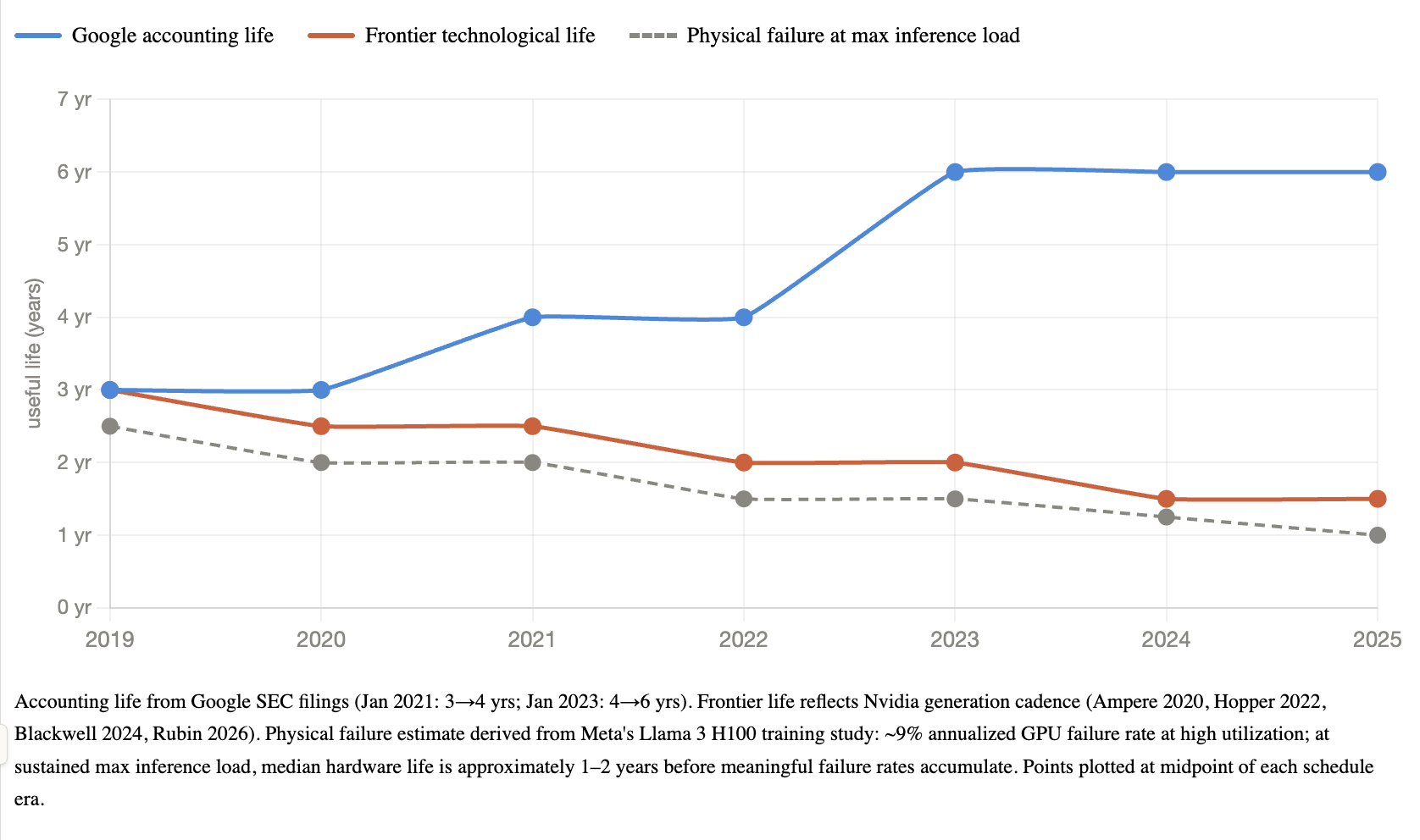
The stellar big tech earnings we saw over the last few years don't actually reflect a material change in the business itself, and the cost of those short-run wins will eventually be repaid in the financial statements. In 2024, Amazon, Alphabet, Microsoft, and Meta spent over $400 billion combined on capex, up from $155 billion in 2023.[1]Alphabet's January 2023 schedule extension, moving servers from four to six years, cut its reported depreciation by approximately $3.9 billion and added roughly $3 billion to net income in that year alone.[2]However, this wasn't because they found a new gold mine in Gemini, nor was this a uniquely Google-y innovation. The cost “savings” were recognized to the benefit of the rest of the business. (See Fig. 1 — the accounting life line stepping upward as the other two decline steadily.) Across the group, the coordinated shift from three-to-four-year schedules to six years reduced reported depreciation across the major hyperscalers by an estimated $18 billion annually.[3]
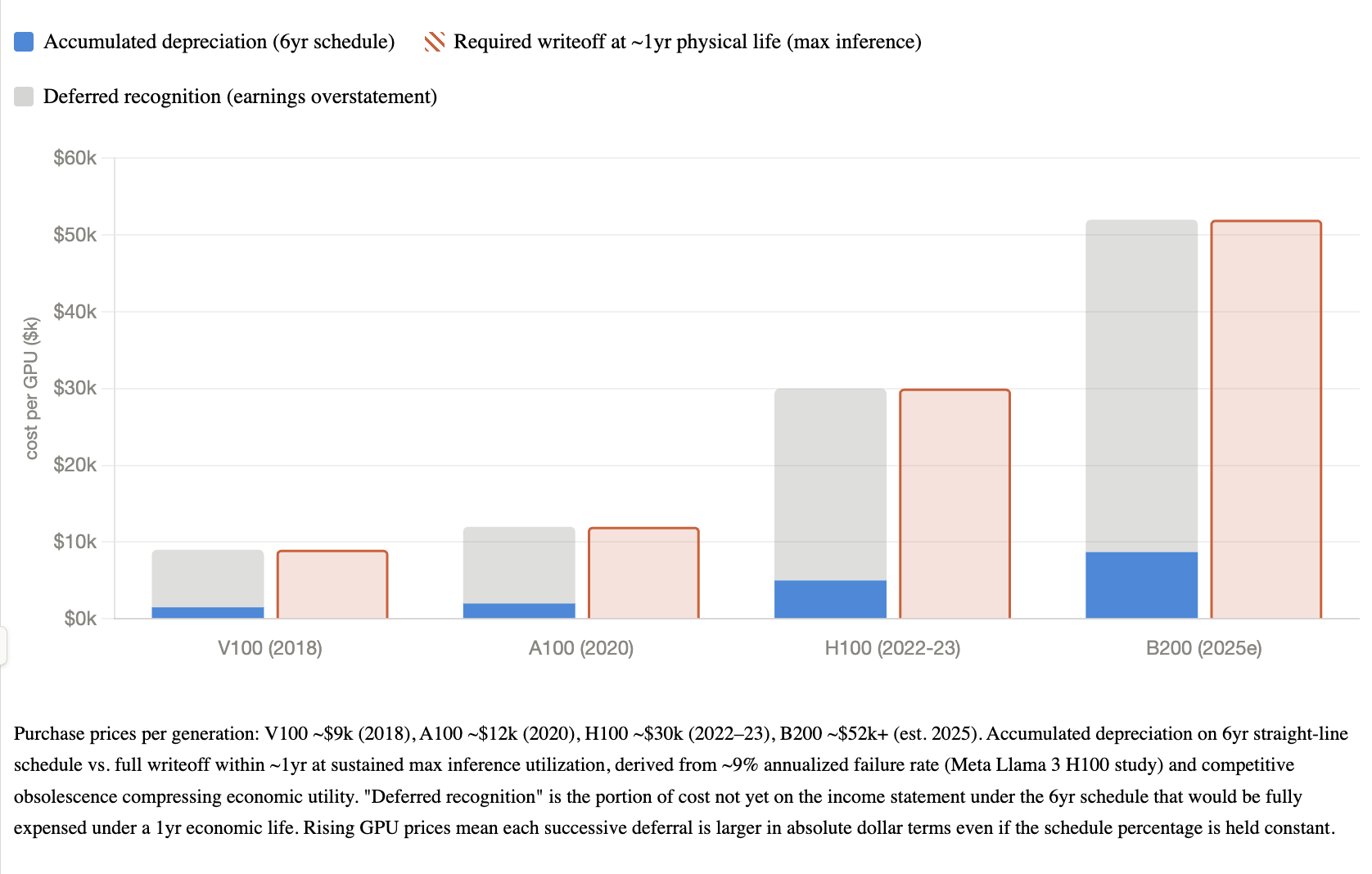
To maintain the same number of frontier GPUs in service, and thus stay relevant in their market, a hyperscaler must spend materially more on each replacement cycle than it spent on the prior one. If it does not, the fleet shrinks in effective compute capacity even if unit count holds steady. (See Fig. 2 — the deferred recognition bar growing with each generation as unit prices rise.) Maintaining reported earnings at current levels therefore requires not just continued capex but rising capex, because the replacement cost of each unit is higher than the cost of the unit being retired. The depreciation charge on the books reflects the old price. The check written to replace it reflects the new one.
Amazon offered a partial acknowledgment of this in early 2025, shortening the useful life of a subset of its servers from six to five years, explicitly citing the accelerating pace of AI and machine learning development — precisely the direction opposite to the extensions it made in 2022 and 2023. The adjustment was expected to reduce 2025 operating income by approximately $700 million on the affected assets, with an additional $920 million in accelerated depreciation taken in Q4 2024 on equipment retired early.[4] The cost was always there. Amazon simply moved part of it from the future to the present. The earnings that looked real in prior periods were, to that extent, borrowed.
The capital allocator's question is therefore not whether earnings are high today. It is whether the business can sustain those earnings without continuously escalating the capital it deploys to replace assets that the accounting schedule says still have years of productive life remaining. As chips burn out and become obsolete at ever faster rates, eventual write downs at or in excess of Amazon's are inevitable. For most hyperscalers at current GPU price trajectories and Nvidia's product cadence, the honest answer is that maintenance of earnings and maintenance of competitive position are the same thing, and both require a capex commitment that the income statement, read naively, gives no indication of. It seems that for both the careless owner and investor, if you aren't careful you might find yourself owning a very expensive pumpkin.
Notes
- [1] Combined capex for Amazon, Alphabet, Microsoft, and Meta in 2024 exceeded $400 billion per company filings and analyst synthesis. Projections for 2025 from the same group are estimated at $417 billion or higher.
- [2] Alphabet's depreciation and net income impact from the January 2023 schedule change sourced from company SEC filings and analyst reconstruction. The $3.4 billion figure disclosed in the Q4 2022 earnings release applied only to assets in service as of December 31, 2022; the full-year 2023 impact on all assets was approximately $3.9 billion.
- [3] The $18 billion industry-wide annual reduction estimate is derived from analyst modeling of fleet size and schedule extension impact across the major hyperscalers. It should be treated as an order-of-magnitude figure; precise aggregate impact is not separately disclosed.
- [4] Amazon's schedule change was from six to five years on a subset of servers and networking equipment, effective January 1, 2025, per the Q4 2024 earnings call and February 2025 SEC filing. The $700 million operating income impact applies to the affected subset only. The $920 million in accelerated depreciation reflects early retirement of equipment in Q4 2024, separate from the schedule change.